Every few months a new tool arrives promising to run the business for you. Most growing companies do not need more tools. They need fewer, chosen on purpose, with the connections between them looked after by someone.
Most of the firms Praxline works with have between two and twenty-five people. This is how I would lay out the stack for a service business that size in 2026, from the bottom up, and where the line sits between paying for software and building your own.
1. One home for each kind of thing.
Clients, jobs and money each need one home, and only one. For a law firm that might be Clio. For an accountancy practice, Karbon for the work and Xero for the money. For a recruiter, an applicant tracking system such as Bullhorn. These are mature, well-supported products, and a small firm should pay for them rather than build its own.
The test is simple. If someone asks where a client's details live, there should be one answer. If there are three, fix that before buying anything new.
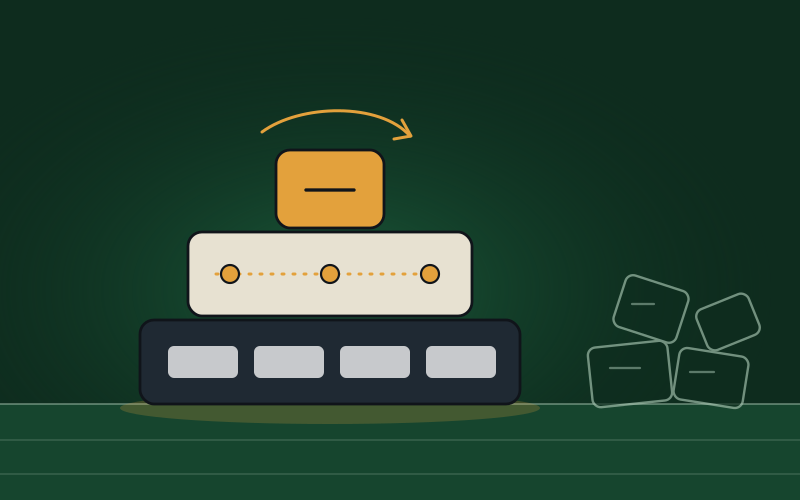
- Buy The systems every firm needs.
- Connect Links between them, monitored.
- Build Only the part that is yours.
2. Connections, watched by someone.
Tools only help if information moves between them without someone typing it in again. For most firms, the long tail of small connections belongs in Zapier, Make or n8n: cheap, quick to set up and easy to change. When the volume grows, or a connection carries something critical like a legal deadline or a client's money, it is worth moving into custom code.
Whichever you use, someone must find out when a connection fails, before a client does. A link that quietly stopped working in March is an easy way to lose a month of enquiries without noticing.
3. A website someone looks after.
WordPress, Webflow and Squarespace are all sound choices for most firms. The platform matters less than whether anyone keeps it updated, tests the updates before they go live, and checks that the contact form still sends. The website is the one part of the stack every client sees.
4. Numbers on one page.
Google Analytics 4 and Looker Studio, pulling in the website, the accounting tool and the job system, cover most of what a growing company needs to see. Five numbers, readable in 30 seconds, is the aim. The founder dashboard note covers which five.
5. AI, in three different places.
AI turns up at three levels of a 2026 stack, and it helps to keep them apart.
- Assistants for everyone. Tools like ChatGPT, Claude and Notion AI for drafting, summarising and searching. Cheap per person and useful from day one, as long as there is a written policy on what client data may go into them.
- Agents for one job. A system built for a single task, such as sorting new enquiries or checking the deadline list each morning, connected to the tools you already have. This is where the measurable hours come from.
- Tools for the people building your software. Cursor, Claude and similar coding tools make developers faster. Most firms will never touch them. They should see the result in the pace and the price of the work.
A firm that only has the first kind has bought a better word processor. The second kind is where AI starts to change the week, and it needs the same care as any other system: someone who knows what it does when it is wrong.
Pay for it, or build it?
Pay for anything that works the same way in every business: email, calendars, accounting, practice management, the website platform. Build only the part that is genuinely yours, the part that makes clients choose you.
A recruiting firm we worked with is a good example. Clients kept asking where their shortlisted candidates were, and the portals on the market were either built for high-volume staffing or meant replacing the firm's applicant tracking system. So we built a client portal on top of the system they already had, and the firm now leads its sales conversations with it. The core system stayed bought. The part that set them apart was built, and they own every line of it.
Whatever you buy or build, keep every account and every line of code in the company's name, not the supplier's, and not in the name of whoever set it up. If you would like a second opinion on what you pay for now and what you could drop, drop me a line, or see what we build and run.