 Praxline
An operations app that reads the orders customers email and keeps the records a recall needs
55 of 55
Product lines found in the 14 sample order emails, 54 of them with the exact quantity, with no AI model
23 of 24
Lines read exactly from 10 emails the reader had never seen, with every customer, message type and delivery day right
11
Automated tests, from the order reader and stock allocation to traceability, permissions and partner statements
The problem
Small producers who cut, cure and deliver their own product run on email, paper and memory. Orders arrive as "the usual plus 5kg mince", "3 of the big pork pies" or a hotel purchase order PDF, and someone in the office types each one in. Joints are ordered by the piece but invoiced on weight. Stock has short use-by dates, so the wrong batch going out first means waste.
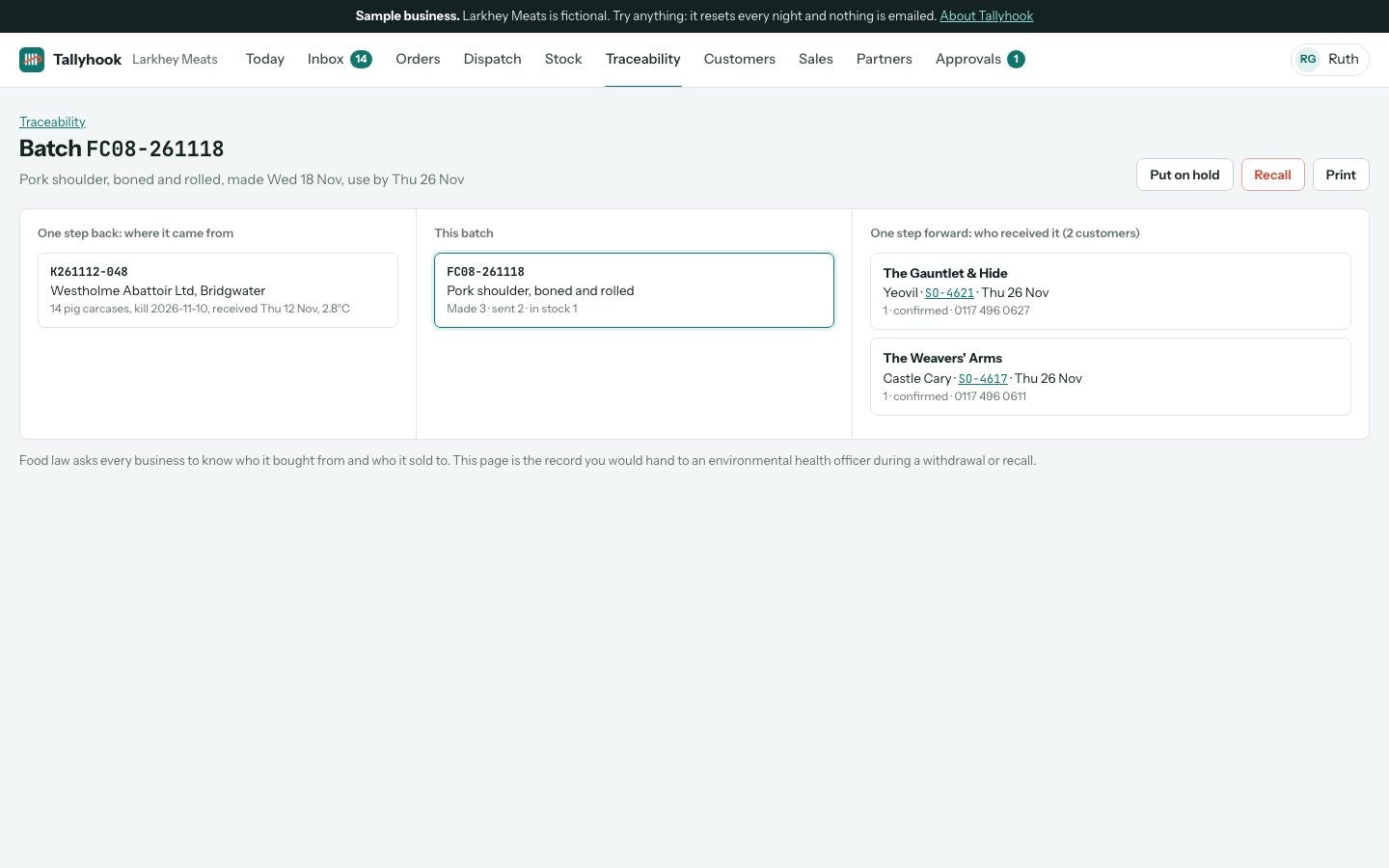
Food law also asks every business to know who it bought from and who it sold to, one step back and one step forward, and to produce those records promptly in a withdrawal or recall. In a small business that record usually lives in a delivery-note folder and someone's head.
The solution
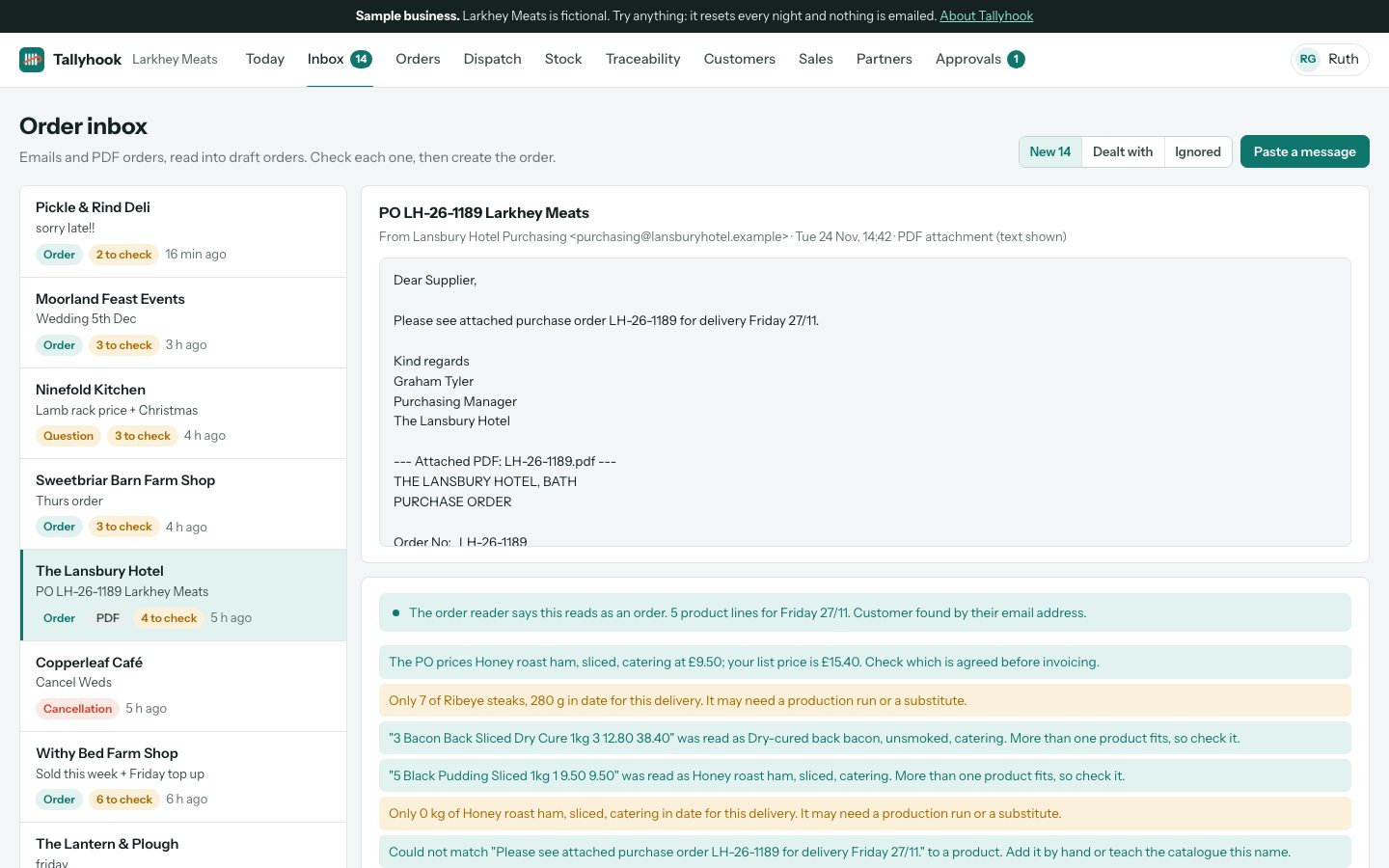
Tallyhook reads every order email and PDF into a draft. A rules engine identifies the customer from the sender, tells orders from cancellations, complaints and price questions, works out the delivery day (moving orders that arrive after the cut-off), and matches the customer's words to the catalogue using product names, the business's own aliases and that customer's order history. It converts pounds, dozens, bags, boxes and kilos of joints into the product's own unit, expands "the usual" for the right weekday, and flags anything it is unsure of. Nothing becomes an order until a person accepts it.
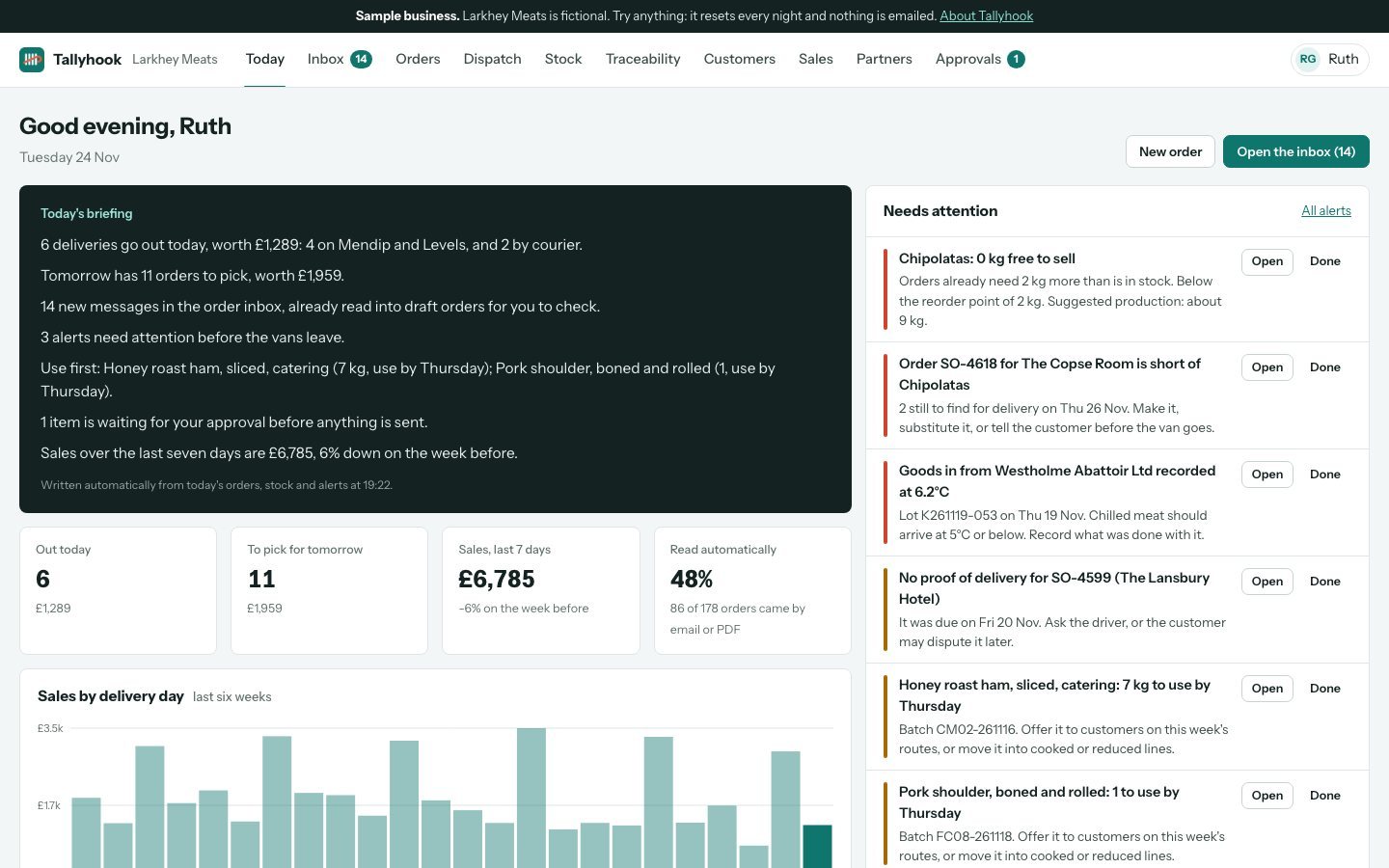
Each production run is a batch with its own use-by date and the supplier lots it came from. Orders take stock from the batch that runs out soonest, so a recall screen can list every customer who received a batch within seconds. Drivers get their run on a phone and record who signed, courier parcels get a waybill label with a QR code, farm shops on sale or return, commission or profit share get monthly statements, and a briefing each morning is written from the day's figures.
How it is built
The order reader
Plain JavaScript rules, no AI service and no per-email cost. It scores catalogue products on name words, aliases, rare words and the customer's history, ranks every date in a message by context ("for Friday" beats "I'm off tomorrow"), reads purchase-order tables, and compares PO prices with the list. It was tested on 14 sample emails, then on 10 it had never seen.
Stock and traceability
Batches, supplier lots and allocations in SQLite. Allocation is first expiry, first out, and cancelling an order puts the stock back. Every batch can be traced to its lots and to each delivery it went out on.
Rules that watch the business
Expired and short-dated stock, products below their reorder point after this week's orders, orders that cannot be filled, held batches on outgoing orders, missing proof of delivery, goods in above 5°C and regular customers gone quiet. Alerts close themselves when the cause is fixed.
Roles and approvals
Owner, office, production and driver each see only their own parts. Replies and partner statements wait in an approvals list before anything is sent.
Sample business
Larkhey Meats, a fictional family producer with 39 products, 35 trade customers on three van rounds and a courier, and ten weeks of trading worked out day by day so every order, batch and alert is consistent. It rebuilds itself every night.
Technologies
Inside the working demo
- An order inbox that reads emails and PDF purchase orders into draft orders, with confidence per line and a way to teach it new words.
- Standing orders per delivery day, with emailed changes applied on top.
- Catch-weight products ordered by the joint, weighed at picking and valued on the actual weight.
- Batches, goods in with temperatures, oldest-first allocation and one-screen traceability with hold and recall.
- Van runs, run sheets, a driver view with proof of delivery, and courier waybill labels with a QR code.
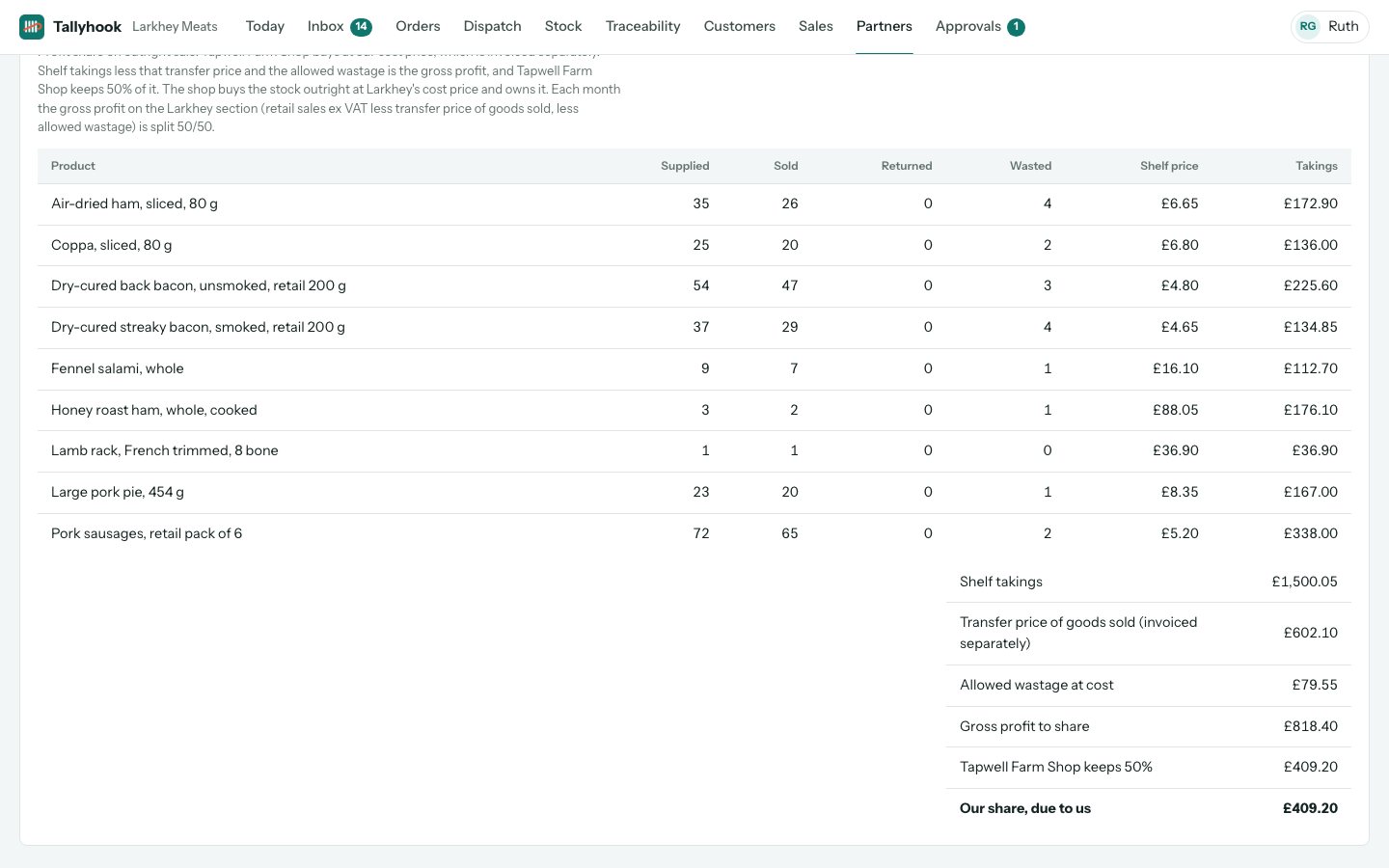
- Sale or return, commission and profit-share statements, a sales pipeline, approvals and a daily briefing.
Tallyhook is a fictional brand built by Praxline to show what a working product in this category looks like. Every person, firm, club, lot and figure in it is sample data, the demo is not indexed by search engines, and nothing on it is a real transaction.
More from the portfolio
Need an operations or automation system for your business?
Start with a 25-minute call: what you do, who uses it, and what it needs to handle. You get a written scope and a fixed price before any work starts.